Associate Professor
Dr. Ravi Hosamani
M.Tech., Ph.D. (ECE)
Explore the circuits, signals and systems that connect our world. Turn understanding into working technology.
Established in 2002, the department brings electronic design and communication systems into the same classroom. Develop the ability to analyse problems, build and test systems, and connect engineering knowledge with practical application.
Laboratory learning is supported by workshops, technical seminars, industrial visits and internships. The department’s focus extends from professional competence to social responsibility and lifelong learning.
Develop skilled electronics and communication engineers who bring professional competence and social responsibility to their work.
Explore selected areas from the third and fourth semesters in VTU’s 2025 ECE scheme, from electronic circuits to communication systems.
View the 2025 schemeVTU · PDFSyllabi for all admission batchesUnderstand how electronic components work together, analyse networks, and describe digital systems using hardware design tools.
Study the behaviour of signals and the systems that process them, with laboratory work connecting analysis to practical communication.
Combine programming and microcontroller concepts with mathematical methods and projects that respond to community and environmental needs.
Course availability follows the university scheme applicable to your admission batch.
 Make the connection.
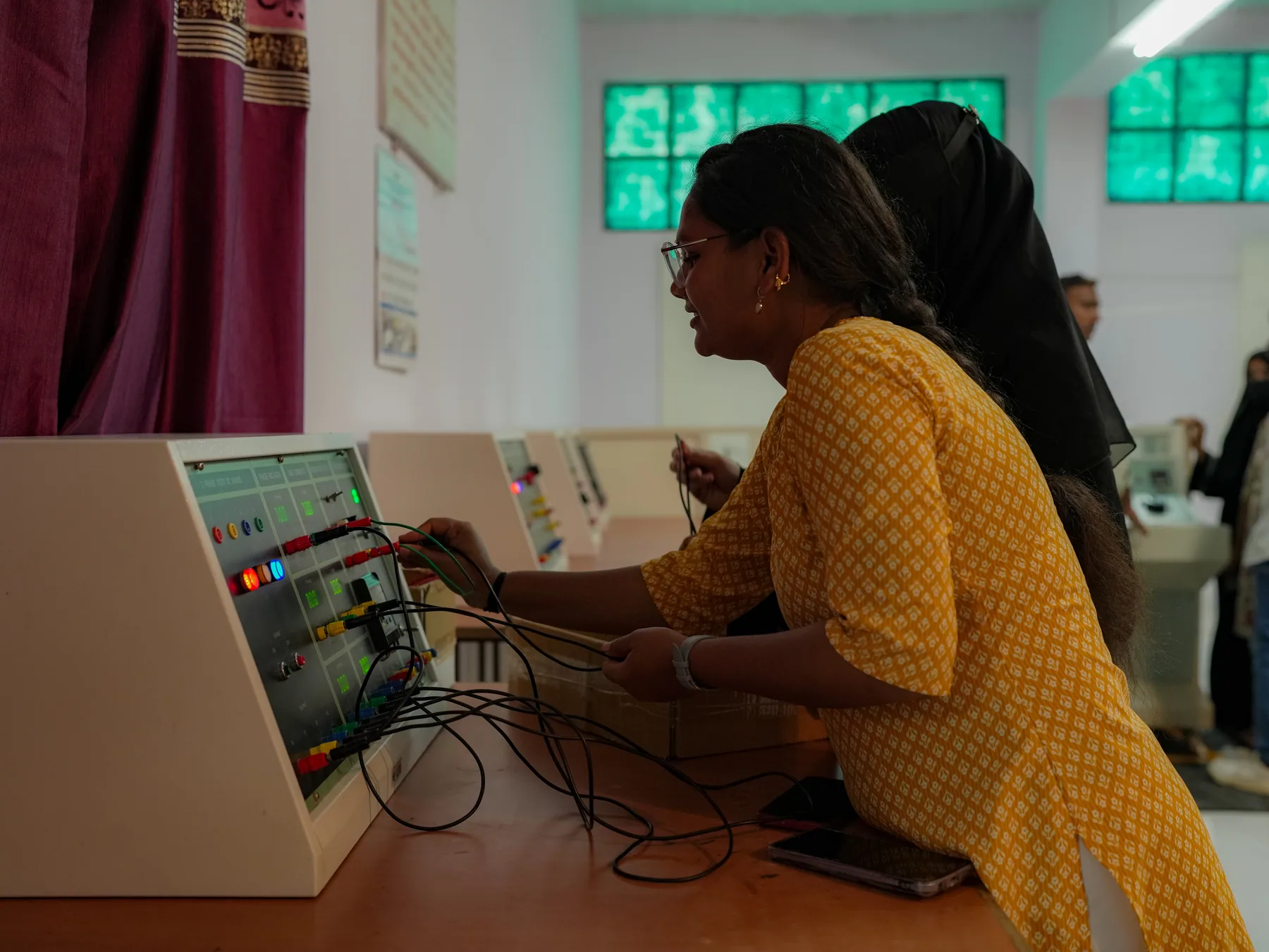
Department laboratories support practical learning and exploration of analog, digital and embedded systems.
Workshops, expert-led colloquia, industrial visits and internships connect classroom learning with professional practice.
SIET lists a research centre in Electronics & Communication Engineering and postgraduate study in Digital Electronics.
M.Tech., Ph.D. (ECE)
B.E. (ECE), M.Tech. (IE)
B.E. (ECE), M.Tech. (DEC)
B.E. (ECE), M.Tech. (DCN), Ph.D. (Biomedical Signal Processing)
Meet the teaching team.
Make your interest in electronics & communication engineering the beginning of something bigger.
Pass 2nd PUC / Class 12 with English as one of the languages, Physics and Mathematics, and one of Chemistry, Biotechnology, Biology, Electronics, or Computer Science.
At least 45% aggregate in the qualifying subjects; 40% for Karnataka candidates belonging to SC, ST, and OBC categories.
Contact the admissions office for the applicable admission route, documents, fees, and availability.