Associate Professor & Head of Department
Dr. Wasim Nidgundi
M.Tech., Ph.D.
Explore the systems that power everyday life. Turn an understanding of electricity into practical engineering.
Established in 2009, the department connects electrical and electronic principles with practical applications. Students explore the generation, transmission and use of electricity, alongside the design and performance of electrical equipment.
Outcome-based teaching, laboratory work and research encourage students to think creatively and solve engineering problems. The department’s approach brings technical knowledge together with teamwork, professional responsibility and continuing learning.
Develop skilled electrical and electronics engineers whose professional work contributes to the wider community.
From circuit behaviour to the movement of energy. Explore selected learning areas from the third and fourth semesters of VTU’s 2025 EEE scheme.
View the 2025 schemeVTU · PDFSyllabi for all admission batchesBuild the analytical foundation for understanding circuits and the electronic systems around them.
Study how electrical machines operate, then connect theory with experiments in the laboratory.
Follow electricity from generation to distribution, and explore the fields behind electrical phenomena.
Work with microcontrollers and apply engineering ideas to community and environmental needs.
Course availability follows the university scheme applicable to your admission batch.
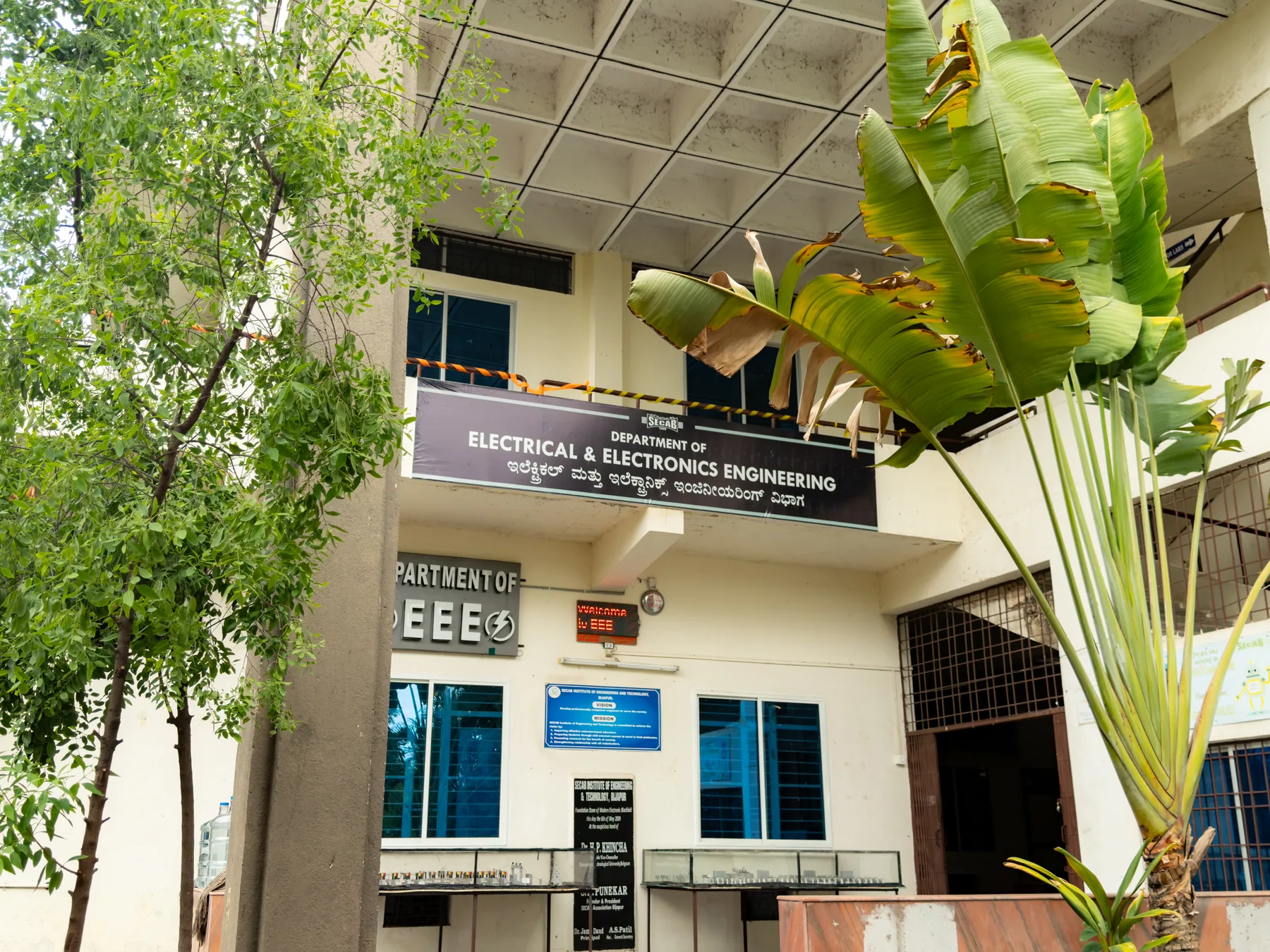 Where ideas find energy.
The department’s laboratories support work with electrical equipment and connect classroom principles to practical experience.
Internship opportunities and a focus on generation, transmission and distribution help students connect learning with professional practice.
SIET lists an Electrical & Electronics Engineering research centre, supporting further investigation alongside undergraduate study.
M.Tech., Ph.D.
M.Tech.
M.Tech.
M.Tech.
Meet the teaching team.
Make your interest in electrical & electronics engineering the beginning of something bigger.
Pass 2nd PUC / Class 12 with English as one of the languages, Physics and Mathematics, and one of Chemistry, Biotechnology, Biology, Electronics, or Computer Science.
At least 45% aggregate in the qualifying subjects; 40% for Karnataka candidates belonging to SC, ST, and OBC categories.
Contact the admissions office for the applicable admission route, documents, fees, and availability.